

Ask an HR leader how their workforce is doing and the answer will usually come from an engagement survey. Scores on commitment, satisfaction and intent to stay have become the shared vocabulary of people strategy. They are useful, but they are also incomplete.
Engagement data tells you how people experience the organisation. It says very little about employee self-perception: what they believe they are capable of, how they respond to pressure, and whether they can articulate their own value when it matters. Those self-beliefs shape how every individual shows up in a team, a change programme or a performance review. When they go unmeasured, organisations end up treating the symptoms they can see while the underlying cause stays invisible.
This is the argument at the centre of Dr Mariheca Otto‘s work. As founder and managing director of Motto Consulting & Surveys, she has spent two decades building one of Southern Africa’s most extensive longitudinal people datasets, spanning 20 years, 13 industries, more than 15,000 data points and 10 countries. Her Motto Self-Perception Survey™ applies the same longitudinal discipline to the individual, drawing on 13 years of data across more than 1,100 people.
Why Engagement Data Only Tells Half the Story
Engagement surveys were designed to answer an organisational question: how do people feel about working here? They aggregate individual responses into team, function and company-level patterns, which is precisely what makes them valuable for spotting cultural trends. It is also what makes them blind to individual-level dynamics.
Consider two employees with identical engagement scores. One feels committed because the work energises them. The other feels committed because they cannot imagine saying no, even as their capacity erodes. On a dashboard, they look the same. In reality, one is thriving and the other is heading towards burnout.
The Motto Model™, developed through Dr Otto’s doctoral research in internal marketing, was built around this kind of distinction. It measures how people actually experience their organisation rather than what they say about it, and the results have proven predictive: in every case where Motto data declined across two consecutive assessments, visible organisational disruption followed within 12 to 18 months. Applying the model’s seven constructs at the individual level is what allows HR leaders to see the layer that engagement surveys flatten.
Three Patterns Standard HR Diagnostics Cannot Detect
The high-commitment burnout profile
High engagement is usually read as a good sign. But research from Yale’s Center for Emotional Intelligence found that roughly one in five employees reported both high engagement and high burnout, and that this group showed stronger intentions to leave than even their disengaged colleagues. Self-perception data helps explain why. When commitment is tied to identity rather than energy, people keep giving long after it starts costing them. An engagement survey records the commitment. It misses the cost.
The self-advocacy gap
Some employees score highly on internal confidence yet consistently fail to translate that confidence into how they present their contribution. They believe in their abilities privately but under-represent them when it counts. The result is a quiet distortion in talent data, where decisions about who gets promoted and paid more are shaped as much by self-presentation as by actual performance.
The belief management floor
Leadership development programmes routinely teach skills, models and behaviours. What they rarely address is the set of underlying beliefs that determines whether those skills hold under pressure. Self-perception data points to a floor of unexamined beliefs that limits how durable any leadership development investment can be. Participants leave a programme with new tools, then revert when stress returns, because the belief system underneath never shifted.
The Development Gaps Training Keeps Missing
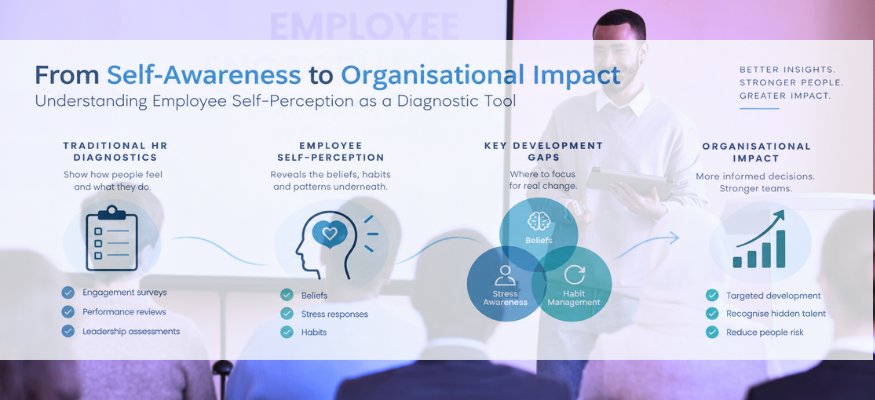
Across 13 years of self-perception data, three individual development gaps stand out for their persistence: belief management, stress personality awareness and habit management.
What these three have in common is that they sit below the level most programmes are designed to reach. Belief management concerns the assumptions people hold about themselves and their circumstances. Stress personality awareness is about recognising one’s own characteristic response to pressure before it shapes behaviour. Habit management is the ability to change the daily routines that ultimately determine whether new learning becomes new practice.
This echoes a long-standing critique of corporate learning. Analysis of why leadership training so often fails found that people frequently slip back into old ways of working once programmes end, and that organisational context, not curriculum, often decides whether learning sticks. Self-perception data adds an individual dimension to that argument. Even in a supportive context, development stalls when a programme assumes participants can change behaviour without first changing how they see themselves.
The practical implication of this for HR leaders is uncomfortable but useful: more content will not close these gaps. Diagnosing them at the individual level, and designing interventions around what the data shows, is what moves the needle.
Recognising the Self-Advocacy Paradox in Your Workforce
The self-advocacy paradox deserves particular attention because it directly affects fairness in talent decisions. Employees who rate themselves highly on internal confidence would seem the least likely to undersell themselves. Yet Otto’s data shows the opposite pattern: confidence in one’s capability does not automatically translate into the ability to advocate for it.
This aligns with wider evidence. Experimental research on self-promotion found that people often describe their performance to potential employers less favourably than equally performing peers, with a persistent gap between women and men where the former were more likely to present their performance less favourably, even when there was no incentive to hold back. This suggests the issue is not necessarily a lack of ability, but how people assess their own performance and communicate their achievements to others.
For HR, the implications reach into several processes at once:
- Performance reviews that lean heavily on self-assessment may systematically reward self-presentation over contribution.
- Talent reviews can overlook high performers who do not put themselves forward.
- Salary negotiations may widen pay gaps that have nothing to do with the value people deliver.
Targeted intervention starts with visibility. When organisations can identify which employees carry a self-advocacy gap, they can adjust calibration processes, coach managers to draw out contribution rather than wait for it, and support individuals in articulating their value with evidence.
Designing Integrated People Diagnostics
The most useful takeaway from this approach is not that self-perception data should replace engagement surveys. It is that neither dataset is complete on its own.
Engagement data shows where the organisation is building or eroding commitment. Self-perception data shows how well individuals are equipped to respond to that environment. Combined, they produce a people risk picture that neither can generate alone. A team with strong engagement scores and a cluster of high-commitment burnout profiles carries a very different risk from a team with the same scores and healthy self-perception. A culture initiative that lands well at organisational level may still falter if the people expected to lead it carry unaddressed belief management gaps.
For OD and people development teams, integration can begin with a few practical steps:
- Map where engagement and self-perception results agree and where they diverge, since divergence is often where hidden risk sits.
- Use individual self-perception profiles to target development, rather than putting entire cohorts through identical programmes.
- Track both datasets over time. Otto’s engagement research shows that trend lines, not single snapshots, are what signal disruption ahead.
- Feed self-advocacy insights into talent and pay processes so that decisions reflect contribution rather than self-presentation.
Where this conversation is happening
Learning to see the individual without losing sight of the system is exactly the kind of challenge senior HR leaders will be working through together at Horizon Summit.
Dr Mariheca Otto will lead the masterclass, “From Self-Awareness to Organisational Impact: Understanding Employee Self-Perception as a Diagnostic Tool” at the summit. Participants will work through the seven constructs of the Motto Model™ at the individual level and leave with a practical framework for bringing self-perception data into their own OD and people development work.